Surf Club: A Designer’s Real-World Embroidery Review
As someone who’s stitched hundreds of designs onto everything from baby onesies to boutique aprons, I opened Surf Club expecting a breezy, sun-bleached vibe—and got exactly that. But first impressions only go so far. What matters is how it holds up when threaded, hooped, and stitched on real fabric. So I tested it across three actual projects: a heavyweight cotton tote for a local surf shop, a soft French terry sweatshirt for a holiday gift, and a linen tea towel for a small-batch kitchen line. Here’s what Surf Club does—and doesn’t—do well in practice.
First Stitch, First Impression
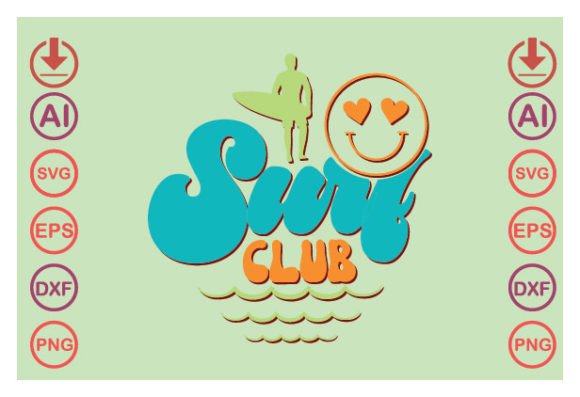
The design reads instantly: relaxed, coastal, slightly retro—but not kitschy. It’s built around clean lines and open negative space, with subtle texture in the wave motif and balanced lettering. No tiny serifs or fragile flourishes. That’s a huge win. In embroidery terms, this means fewer stitch-density traps, less risk of thread nesting, and better legibility at 3–4 inches wide—the sweet spot for most tote bag design and sweatshirt embroidery work. It feels like a machine embroidery design made by someone who’s actually run a needle through denim and knits.
Where Surf Club Shines (and Where It Needs Care)
Surf Club works beautifully on stable, medium-weight fabrics: canvas totes, midweight cotton tees, linen tea towels, and structured caps. On the tote, the lettering stayed crisp and the wave outline held its shape without over-stuffing. On the sweatshirt, I used a light cutaway stabilizer and a 75/11 needle—no puckering, no distortion. The design’s moderate stitch density kept things breathable and wearable.
But here’s where attention matters: Surf Club isn’t ideal for ultra-fine baby knits or highly stretchy performance fabrics without adjustments. The wave’s curved edge and tight corner at the “C” can blur if hooping tension slips or stabilizer shifts—even slightly—on thin jersey. I’d skip it for newborn onesies unless resized to 2.25" max and stitched with reduced density and a tear-away + topping combo.
It also needs thoughtful placement on curved surfaces. On a structured baseball cap front, I repositioned the design lower and flatter than usual—centering the baseline rather than the full height—to avoid distortion near the bill seam. And on dark fabric? Always test your thread colors. The default navy-and-cream combo looks sharp on heather grey, but on black, the cream satin stitch faded unless I swapped to off-white or ecru thread with a slight sheen.
Real Projects, Real Reactions
Last month, I used Surf Club on a set of custom embroidered pillow covers for a beachside Airbnb host. Guests loved the laid-back energy—it felt intentional, not mass-produced. That’s the quiet strength of this design: it supports handmade storytelling without shouting. Buyers don’t see “SVG file” or “DXF”—they see craftsmanship, cohesion, and care.
For Etsy sellers and small shop owners, Surf Club is a reliable anchor design. It pairs cleanly with minimalist mockups, scales well for digital previews, and reads clearly even in thumbnail size. As a digital embroidery file, it’s versatile—but only if you treat it like a tool, not a shortcut. Its simplicity is its strength, not a limitation.
Design Notes You’ll Actually Use
- Always test on scrap fabric first—especially with textured weaves like waffle-knit towels or looped terry. What looks smooth on screen can snag or float in stitch.
- Check contrast early. Run a quick black-and-white mockup to confirm letterforms hold weight on both light and dark backgrounds.
- Review stitch density before hooping. If your machine allows editing, reduce fill density by 5–10% on dense areas like the wave crest—this improves drape and wash durability.
- Confirm hoop size compatibility. While Surf Club fits comfortably in a 4x4 hoop, double-check your layout if combining it with borders or monograms.
- Inspect small details at 200% zoom. The curve where the “S” meets the wave has a gentle taper—not a hard point. That subtlety prevents breakage during stitching, but only if digitized cleanly (which it is).
- Use proper stabilizer: light cutaway for knits, tear-away for stable wovens, and a light topping for napped fabrics like fleece.
- Verify licensing before selling finished items. Since this is listed as a Graphics download with SVG/DXF files—not native embroidery formats—confirm whether commercial use is permitted for physical products or resale of stitched goods.
Not Just for T-Shirts
Calling Surf Club a T-Shirt Designs asset undersells it. Yes, it works on tees—but its rhythm and spacing make it especially strong on wider surfaces: aprons, blanket corners, oversized pillow fronts, and even folded-over patch edges. I turned one version into an iron-on embroidered patch using lightweight fusible web and a satin-stitch border—clean, durable, and shop-ready in under 12 minutes.
It also bridges seasonal gaps. Used in navy thread on ivory linen, it reads as timeless coastal decor. Swap to coral and sand tones, and it becomes a summer baby gift. Add a tiny anchor icon beside it (digitally or by hand), and it’s wedding favor-ready. That flexibility is rare—and valuable—for creative entrepreneurs juggling multiple product lines.
Final Thought: Design Integrity Over Flash
Surf Club won’t wow with complexity. There are no 3D puff effects, no gradient fills, no multi-layer applique. Instead, it delivers something rarer in digital design libraries: consistency, clarity, and quiet confidence. It stitches cleanly, photographs well, and feels human-made—not algorithmically generated. For makers building trust through detail, it’s a grounded, repeatable choice. Not every project needs fireworks. Sometimes, what you need is a wave that lands just right.