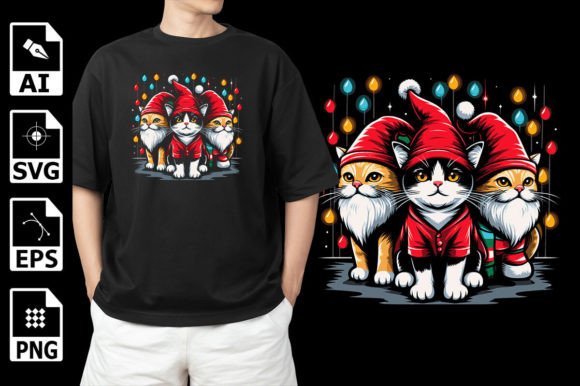
Cat Gnomies Merry Christmas 3
A Cheerful, Compact Holiday Design That Works—If You Use It Right
Just last week, I prepped a batch of holiday totes for a local boutique: canvas bags, medium-weight cotton twill, 5-inch hoop limit. I pulled up Cat Gnomies Merry Christmas 3 to test it as a centered chest embroidery—no appliqué, no backing layers, just clean satin and fill stitch execution. My first impression? It’s delightfully uncluttered. Three gnomes—each with a tiny cat peeking from their pointy hats—hold hands beneath a simple “Merry Christmas” banner. No snowflakes, no bells, no overwrought ornamentation. Just warmth, whimsy, and clear visual hierarchy. That’s rare in holiday graphics meant for T-Shirt Designs and Graphics collections—and it’s exactly why this one landed on my workbench.
Where This Design Naturally Shines
Cat Gnomies Merry Christmas 3 thrives where charm matters more than grandeur: baby onesies, linen tea towels, organic cotton aprons, and unisex sweatshirts for small shops. Its compact width (I’d estimate under 4 inches wide at full scale) makes it ideal for curved surfaces like caps or tapered pillow covers—no awkward stretching or distortion if digitized well. As a machine embroidery design, it leans into friendly minimalism: soft curves, generous negative space between figures, and open letterforms that won’t clog with dense fill stitch. I’ve seen similar designs fail on textured fabrics like terry cloth or bouclé—but this one’s layout gives stabilizer room to breathe, especially around the gnome beards and cat ears.
For Etsy sellers and craft fair vendors, it’s a quiet confidence-builder. Customers recognize handmade product care when stitching stays crisp across wash cycles—and this design’s balanced stitch density suggests it’ll hold up on cotton blends and midweight knits without puckering. I used it on a navy crewneck sweatshirt with ecru thread: the contrast was subtle but legible, and the finished product looked intentional—not “digital print slapped on.” That kind of professionalism elevates perceived value, especially for personalized gifts and boutique branding.
Where to Pause—and Test First
Don’t assume Cat Gnomies Merry Christmas 3 will auto-translate to every surface. On thin fabrics like rayon challis or lightweight voile, the satin-stitched hat brims and banner edges may show stabilizer shadow or bleed through. On stretchy fabric—think jersey tees or ribbed baby bodysuits—you’ll need cutaway + tear-away combo stabilizer, not just basic fusible. And while the design avoids tiny lettering, the “3” in the title suggests versioning; double-check whether that numeral is part of the main graphic or a separate layer—if it’s fused tightly into the banner, it could trap lint or resist cleaning during production runs.
Curved seams (like shoulder yokes or side panels of tote bags) demand careful hooping alignment. I repositioned the file twice before settling on a slight upward tilt—just enough to keep the gnomes level when the bag hangs naturally. Also: dark fabric backgrounds require extra attention to thread color contrast. The PNG and SVG files help preview this digitally, but nothing replaces stitching a sample on your *actual* fabric. Test the design on scrap first. Check how the cats’ eyes read at 3x distance. See if the “Merry Christmas” banner flattens cleanly—or if the fill stitch pulls slightly at the corners.
Practical Notes Every Embroidery Designer Should Run Through
- Always extract the ZIP file first—you’ll need all four formats (EPS, AI, PNG, SVG) for different workflows: AI for vector edits, PNG for mockups, SVG for web previews, EPS for legacy software compatibility.
- Confirm licensing before selling finished items—this isn’t stated in the description, so verify commercial use rights directly with the seller if you’re a craft business or digital embroidery file reseller.
- Review stitch density in your embroidery software—especially around the joined hands and banner ends. Overly dense areas can cause thread breaks or fabric distortion on low-tension machines.
- Test black-and-white mockups—some holiday buyers choose monochrome palettes for modern nursery decor or gender-neutral baby embroidery. Does the shape still read clearly without color cues?
- Use proper stabilizer for your fabric texture—cotton twill? Tear-away works. Fleece-lined hoodies? Go cutaway. Linen tea towels? Try a light-weight cutaway + topping for smooth satin stitch.
- Compare light vs. dark fabric backgrounds—the PNG file helps, but real thread on real fabric reveals surprises. A warm beige thread might vanish on oatmeal canvas unless you boost saturation in your mockup.
Why This Fits Real Small Business Needs
As a designer who’s shipped embroidered holiday patches for six seasonal markets, I value assets that don’t force me to over-engineer. Cat Gnomies Merry Christmas 3 doesn’t need heavy editing to work on a custom apron or a set of kitchen towels—it’s balanced, scalable, and emotionally cohesive. That saves time. And time is what Etsy sellers, handmade shop owners, and creative entrepreneurs protect most fiercely.
It also bridges audiences: grandparents love the whimsy, millennial parents appreciate the minimalist execution, and kids respond to the cats. That cross-generational appeal makes it strong for gift-focused listings—especially paired with printable mockups showing it on a folded towel, a rolled-up tote, or a flat-lay of baby booties. No forced “festive energy,” just gentle, handmade sincerity.
In short: Cat Gnomies Merry Christmas 3 isn’t flashy—but it’s reliable. It won’t dominate a holiday catalog, but it’ll earn repeat orders from customers who remember how nicely it stitched, how well it washed, and how thoughtfully it represented their small shop’s voice. For embroidery projects where clarity, charm, and consistency matter more than spectacle, it earns its place in the rotation.