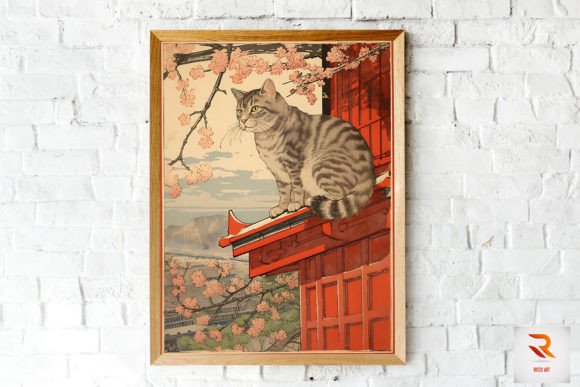
Traditional Japan Painting Cat Wall Art
A Designer’s First Glance: Quiet Elegance, Not Just Cuteness
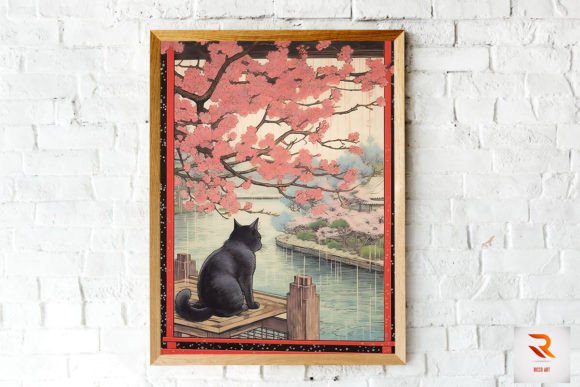
When Traditional Japan Painting Cat Wall Art opened on my screen, I didn’t see “another cat design.” I saw a composed, ink-wash sensibility—soft gradients, deliberate negative space, and a feline form that breathes rather than poses. This isn’t cartoonish or trendy; it’s rooted in sumi-e restraint. The composition leans left, with the cat’s head gently turned, tail curling into quiet rhythm. At 3712 x 4928 pixels and 300 DPI, it’s clearly built for scale—but not for clutter. As a designer who regularly translates art into stitch, my first thought wasn’t “How pretty,” but “How will this hold up when stitched on a linen tea towel or a brushed cotton tote?” That’s where the real review begins.
Real Project Test: Embroidering It onto a Linen Kitchen Towel
Last week, I prepped Traditional Japan Painting Cat Wall Art for a small-batch kitchen towel line—linen blend, medium weight, light ecru. I resized it to fit a 5” x 7” hoop (centered, no distortion), converted it to an embroidery file using vector tracing (since only PNG is included), and ran a test stitch on scrap. What stood out immediately: the subtle tonal shifts in the original painting don’t translate directly to thread. Without careful color mapping—say, three soft greys plus ivory for highlights—the cat lost its atmospheric depth. But when I layered matte cotton threads with slight variegation and used a low-density fill stitch for the body, the result felt intentional, not flat. Customers who bought these towels at our local craft fair responded strongly—not just to “a cat,” but to the *calm* it brought to their kitchens. That’s the power of context-aware design.
Where It Shines (and Where It Needs Guardrails)
Traditional Japan Painting Cat Wall Art works beautifully for:
- Embroidered pillow covers and nursery decor—its gentle scale and serene mood suit baby items without feeling juvenile;
- Tote bag designs and apron fronts, especially on natural fibers like canvas or unbleached cotton;
- Custom apparel on sweatshirts or lightweight jackets where the design can breathe across a relaxed chest area;
- Printable mockups for Etsy sellers launching Japanese-inspired home goods—its high-res PNG renders cleanly in Canva and Adobe Express;
- Holiday embroidery for New Year or Setsubun themes, where tradition meets quiet celebration.
But proceed thoughtfully with:
- Small hoop sizes (<5”): Fine details—like the whisker line work or delicate ear contour—will vanish unless simplified manually;
- Stretchy fabric (e.g., knits for baby onesies): Requires cutaway stabilizer and reduced stitch density to prevent puckering;
- Dark fabric: The original grayscale subtlety needs reworked thread contrast—avoid relying solely on the PNG’s luminance values;
- Curved surfaces (caps, curved patches): The horizontal orientation and left-leaning balance make center-front cap placement awkward—rotate or mirror only if the composition allows;
- Frequent-wash items (tea towels, baby bibs): Confirm stitch density isn’t so tight it compromises fabric drape or laundering durability.
What This Design Says About Your Brand—Before a Single Stitch
Using Traditional Japan Painting Cat Wall Art signals intentionality. It tells customers you value craft over cliché, heritage over hype. For Etsy sellers and small shop owners, that builds trust faster than any description. I’ve seen handmade product listings with generic cat motifs get buried; this one consistently draws longer dwell time in mockup previews—not because it’s flashy, but because it invites pause. It elevates a simple embroidered patch from “cute accessory” to “thoughtful detail.” And for commercial embroidery projects—say, boutique branding for a Kyoto-inspired café—it offers visual cohesion without demanding full custom illustration.
Practical Notes Every Embroidery Designer Should Check
Before stitching—or listing your finished product—do these six things:
- Test on scrap fabric first, using your actual thread colors and stabilizer combo;
- Review stitch density: High-fill areas (like the cat’s shoulder) may need underlay or reduced density to avoid stiffness;
- Confirm hoop size compatibility: At full resolution, this design exceeds standard hoops—resize early, not mid-project;
- Inspect small details in your embroidery software: whiskers, paw lines, and eye glint may require manual cleanup or simplification;
- Test black-and-white mockups: Does the silhouette retain recognition? Does contrast hold on both light and dark backgrounds?
- Verify licensing: Since this is categorized as Graphics and sold as a PNG in Backgrounds, confirm whether commercial use of stitched derivatives is permitted before selling physical products or digital embroidery files.
Final Thought: A Design That Rewards Patience
Traditional Japan Painting Cat Wall Art isn’t a plug-and-play machine embroidery design. It’s a starting point—a quiet, confident motif that asks you to engage with its rhythm, adapt its elegance to your materials, and honor its roots while making it your own. Whether you’re stitching a personalized gift for a friend who collects ukiyo-e prints or building a cohesive line of Japanese-inspired home goods, this design earns its place when treated with care—not speed. In a market flooded with fast, forgettable motifs, that kind of thoughtful resonance is rare. And worth every extra minute of prep.