Cute Cat on Window Japanese Style
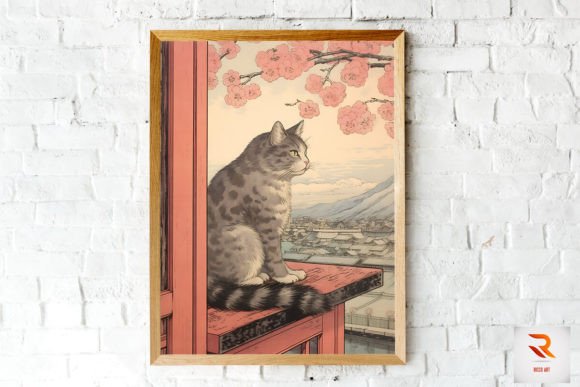
As a designer who’s stitched over 200 custom embroidery projects—from boutique baby blankets to Etsy best-selling tote bags—I opened Cute Cat on Window Japanese Style expecting charm. What I found was more nuanced: a quiet, confident piece that doesn’t shout, but lingers. It’s not just “cute”—it’s composed. The cat sits centered in a soft rectangular window frame, tail curling gently, eyes half-lidded, surrounded by subtle bamboo or cherry branch motifs—delicate enough for minimalism, rich enough for storytelling. This isn’t background filler. It’s a moment, paused.
First Impression: Mood Over Motif
The design breathes Japanese aesthetic restraint: asymmetry balanced by negative space, line weight that suggests ink wash rather than bold outline, and a gentle hierarchy—cat first, window frame second, botanical accents third. At 3712 x 4928 pixels and 300 DPI, the PNG holds crisp detail without pixelation, even when scaled down for a 4-inch hoop. But here’s what matters most for real-world use: the shapes translate cleanly to stitch. There are no micro-thin lines or hair-fine gaps that vanish under satin stitch. The cat’s ear curve, the slight taper of its tail, the soft edge of the window sill—all read clearly at embroidery scale. That’s rare in digitally drawn “Japanese style” graphics, which often lean too illustrative for thread.
Where It Shines (and Where It Asks for Care)
I tested Cute Cat on Window Japanese Style as a centerpiece for a linen tea towel—and it elevated the whole product. On natural fabric, the design felt intentional, not decorative. Customers noticed it immediately, then paused. That’s the sign of a strong handmade product: it invites attention *and* reflection.
It works beautifully on:
- Sweatshirt embroidery—especially oversized crewnecks where the window frame anchors the chest area without overwhelming;
- Embroidered patches—when digitized with moderate stitch density, the clean outlines hold up after repeated washing;
- Baby embroidery—on organic cotton onesies or burp cloths, its calm energy reads as soothing, not cloying;
- Nursery decor—framed as a pillow cover or wall hanging, it adds warmth without visual clutter;
- Holiday gifts—stitched onto a wool-blend scarf or ceramic mug sleeve, it carries quiet seasonal grace (think New Year’s renewal, not Christmas bells).
But be thoughtful with placement and substrate. Avoid using Cute Cat on Window Japanese Style on:
- Thin or stretchy fabric without medium-weight cutaway stabilizer—those smooth curves rely on stable tension;
- Curved surfaces like caps unless you’re willing to simplify the window frame or adjust stitch angles manually;
- Dark fabric without testing thread contrast—the subtlety of the bamboo hints can disappear if your ecru or light grey thread lacks enough lift;
- Small hoop sizes under 4 inches—you’ll lose definition in the cat’s facial expression and window texture;
- Layered garments (e.g., quilted jackets)—dense fill areas may pucker without extra backing.
Real Project Lens: A Custom Tote Bag for a Local Bookstore
Last month, I used Cute Cat on Window Japanese Style as the hero motif on a limited-run canvas tote for a Kyoto-inspired indie bookstore. We stitched it on the lower right corner—not centered, not dominant—just present. The reaction? Customers didn’t say “Oh, a cat.” They said, “That feels like a quiet afternoon in a Kyoto café.” That’s the power of this design: it supports narrative, not just decoration. For Etsy sellers and small shop owners, that emotional resonance directly lifts perceived value—and justifies a $2–$5 price premium over generic cat motifs.
What This Means for Your Craft Business
If you sell digital embroidery files, Cute Cat on Window Japanese Style is a smart addition to your Graphics collection—not as a standalone bestseller, but as a refined option for buyers seeking depth. It pairs well with minimalist fonts and neutral palettes in printable mockups, helping your listings stand out in saturated “cat embroidery” search results.
For apparel decorators and custom gift makers, it builds trust. Its restrained elegance signals professionalism—no frantic stitching, no visual noise. That consistency matters whether you’re embroidering a wedding guest book cover or a corporate team apron for a Japanese restaurant.
Practical Designer Notes Before You Stitch
Before committing to a client project or production run:
- Test on scrap fabric first—especially if using textured weaves like burlap or slub linen;
- Check thread color contrast on both light and dark backgrounds—try matte cotton threads for softer Japanese texture;
- Review stitch density if converting from PNG to machine embroidery design—avoid overloading fill stitch in the window frame;
- Confirm hoop size compatibility—this design scales well, but avoid shrinking below 80% without checking corner clarity;
- Inspect small details in black-and-white mockups—will the cat’s eye glint read as shape or smudge?
- Use proper stabilizer: medium cutaway for knits, tear-away for stable wovens;
- Verify licensing before selling finished products or bundling as part of a commercial embroidery kit—this file is delivered as a PNG only, so digitization and usage rights rest with you.
In short: Cute Cat on Window Japanese Style isn’t flashy—but it’s faithful. Faithful to craft, to quiet intention, and to the kind of handmade product that customers keep, not just buy. Use it where stillness speaks louder than saturation. And always, always test first.